
Field notes from Marina Martello, a Veneto genealogist.
Genealogy Research in Veneto: Dioceses, Parish Records & Civil Archives
Genealogy in the Venetian lands does not forgive improvisation: centuries-old diocesan borders, the handover from Austrian to Italian civil registration, parish funds scattered across the State Archives. What follows is my own working map of the territory — the one I use when a family tree lands on my desk.
Work a Veneto ancestor back past 1871 and the map you need stops being Italy's — it becomes the Church's. Civil registration as we know it barely existed; what governed a birth, a marriage, a death was the parish, and the parish answered to its diocese, not to the comune you'll find on a modern map. Veneto counts ten dioceses, and I've yet to find one whose borders behave and sit neatly inside the seven provinces drawn later. Two banks, one method: church records on one side, state records on the other — different keepers, same way of tracing a name through them — and the same house rule every time: verify locally before a date goes into someone's family tree.
Church bank — diocese, parishState bank — comune, Archivio di Stato
Overview
What lives where
Three kinds of office have held birth, marriage and death records in Veneto, and knowing which one you're dealing with saves a wasted trip. This is the map I hand every client before we go looking for a single name.
Parish / diocesan archive
1563/64 — today
- Baptisms, marriages, deaths, stati d'anime (household census).
- Kept from the Council of Trent's 1563–64 decrees onward, though many Veneto parishes have earlier registers.
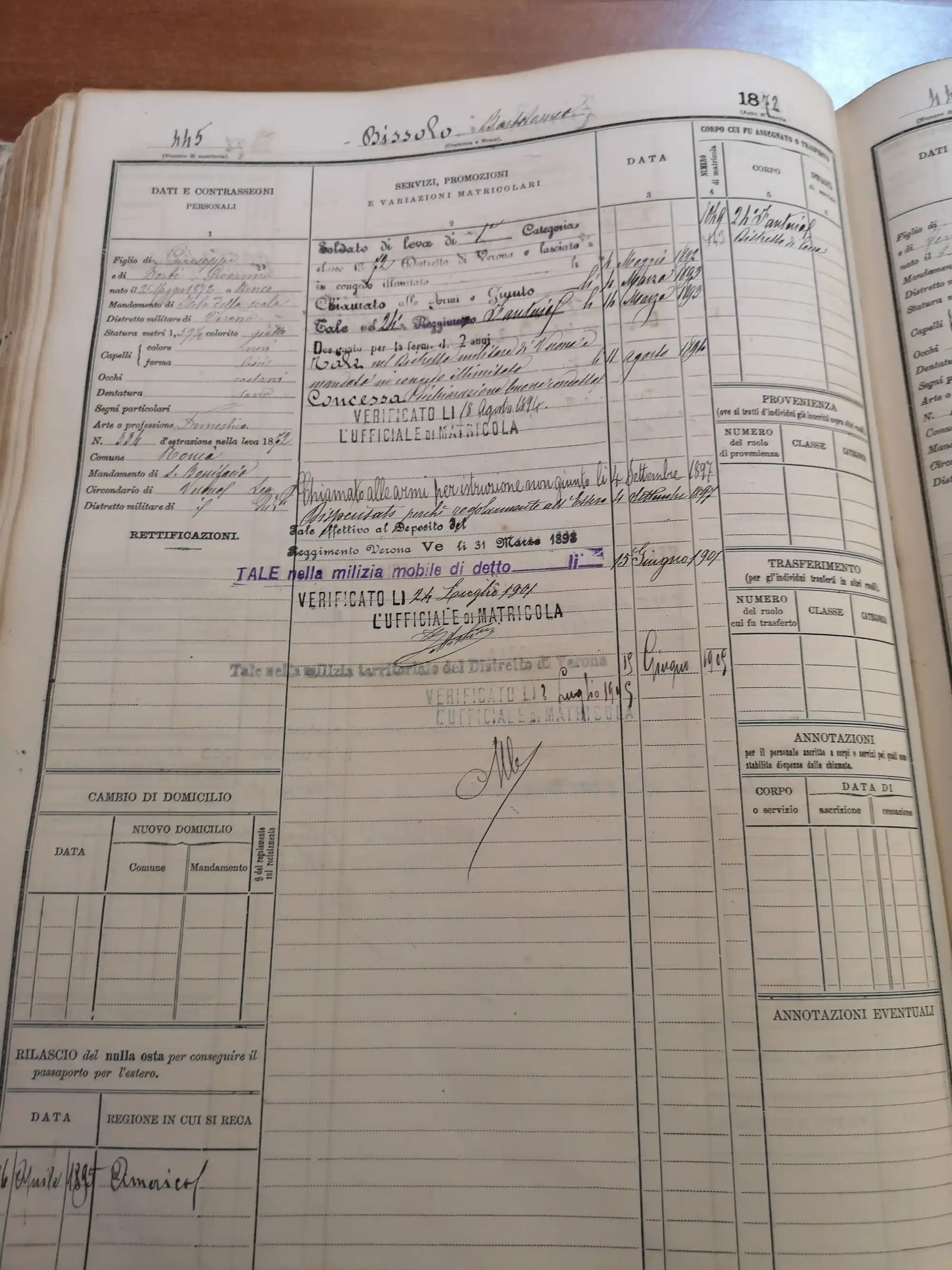
- Between 1815 and 1871, under the Kingdom of Lombardy–Venetia, registry functions were delegated exclusively to the parroco — these registers carried full civil validity, not just religious.
- Held either at the parish itself or, for suppressed and urban parishes, concentrated at the diocesan archive — this varies by diocese.
Comune / Anagrafe
1871 — today
- Stato civile italiano: birth, marriage, death and residency records.
- Italian civil law took effect nationally on 1 January 1866, but reached Veneto only from 1 September 1871, after annexation.
- Recent records (roughly the last 70–100 years) usually still sit with the comune's own registry office.
Archivio di Stato
1806–1815, and 1871 onward
- Stato civile napoleonico (1806–1815) — organised by department, not by today's province.
- Older stato civile italiano registers, transferred from the comuni after several decades.
- Military conscription rolls, notarial deeds, land registers (catasto) — useful once you're past the registers.
Layer 1 — Dioceses
The ten dioceses of Veneto
The Patriarchate of Venice and nine suffragan dioceses — the ten filing cabinets you actually need, whatever the modern comune says. Where a field reads "varies by parish", it means exactly that: no single date for a whole diocese until the parish itself confirms it — and online coverage, where it exists, may not be complete.
Ecclesiastical province of Venice: the Patriarchate and its nine suffragan sees.
Patriarchate of Venice
Seat: Venice.
Diocesan archive: Archivio Storico del Patriarcato di Venezia — archiviostoricodelpatriarcatodivenezia.it. Reading room by appointment only, on a motivated request sent by email, against the seasonal calendar the archive publishes on its own site.
Parish records from: most Venetian parishes hold nothing earlier than the Council of Trent (1563); continuous series typically begin only in the late 1500s or early 1600s. There is no single diocese-wide opening date to quote — check each parish's own fund on Ecclesiae Venetae.
Diocesan archive vs parish: "diffuse diocesan archive" model — some parish funds are catalogued and partly deposited at the Patriarchal archive; others remain at the parish.
Online portals: BeWeB (fund descriptions). The Napoleonic stato civile (1806–1815) is digitised and on the Portale Antenati; the post-1871 stato civile, long held on deposit at the tribunal, was photographed by FamilySearch. Parish registers are not fully digitised — inventories on BeWeB and SIUSA / Ecclesiae Venetae.
Notes: heir of the Patriarchate of Grado (1451); absorbed the suppressed sees of Equilio/Jesolo (1466) and Caorle and Torcello (1818). Venice's own Pellestrina island belongs instead to the Diocese of Chioggia.
Adria-Rovigo
Seat: dual — cathedra in Adria, curia and bishop's residence in Rovigo.
Diocesan archive: Archivio Diocesano di Adria-Rovigo, Rovigo — diocesiadriarovigo.it; requests run through the diocesan Servizio Antenati.
Parish records from: discontinuous before 1800 — the Polesine took repeated Po and Adige floods and passed back and forth between Ferrara and the Republic of Venice, and the surviving registers show it. Don't expect the tidy pre-1800 continuity you'll find further north; check what each parish actually has.
Diocesan archive vs parish: varies by parish — confirm with the parish or the diocesan archive.
Online portals: BeWeB — coverage varies by parish and may not be complete.
Notes: centuries-old dual-seat arrangement: Adria kept the title, Rovigo kept the bishops.
Belluno-Feltre
Seat: dual — Belluno (cathedral) and Feltre (co-cathedral).
Diocesan archive: Archivio Diocesano di Belluno-Feltre — chiesabellunofeltre.it.
Parish records from: varies by parish — no single date to quote.
Diocesan archive vs parish: varies by parish — confirm before you travel or write.
Online portals: BeWeB — coverage varies by parish and may not be complete.
Notes: two ancient sees, separated in 1462. In 1818 Pius VII joined them only aeque principaliter — sharing a bishop, not fusing the structures. Full canonical union came on 30 September 1986, by the decree Instantibus votis.
Chioggia
Seat: Chioggia.
Diocesan archive: Archivio Diocesano di Chioggia, housed in the Seminario Vescovile — poloculturale.diocesidichioggia.it.
Parish records from: varies by parish — no single date to quote.
Diocesan archive vs parish: varies by parish — confirm with the parish or the diocesan archive.
Online portals: BeWeB — coverage varies by parish and may not be complete.
Notes: covers nine centuries of diocesan history. Includes Venice's Pellestrina island (four parishes) even though the island sits within the comune of Venice.
Concordia-Pordenone
Seat: Pordenone since 1974 (the title "Concordia-Pordenone" dates to 1971); bishop's residence at Portogruaro 1586–1974; originally Concordia Sagittaria.
Diocesan archive: Archivio Storico Diocesano di Concordia-Pordenone, Pordenone — contact via the diocese's curia.
Parish records from: varies by parish — no single date to quote.
Diocesan archive vs parish: eighty parish archives are held at the diocesan archive, most of them transferred after the 1976 earthquake; the others remain with their parishes.
Online portals: BeWeB — coverage varies by parish and may not be complete.
Notes: the seat now lies in Friuli-Venezia Giulia, not Veneto — only a slice of the diocese's territory sits in Veneto (parishes around Caorle, province of Venezia). A reminder that diocesan borders never quite match the administrative region.
Padova
Seat: Padua.
Diocesan archive: Biblioteca Capitolare e Archivio Storico Diocesano — diocesipadova.it; genealogical research runs on its own dedicated request form, not the ordinary reading-room route.
Parish records from: varies by parish — no single date to quote.
Diocesan archive vs parish: registers of the parishes suppressed or merged after the Napoleonic reorganisation were centralised at the diocesan archive; the civil-status registers kept by parroci for the whole comune of Padua arrived around 1920. Everything else generally stays with the parish.
Online portals: BeWeB; diocesan "Servizio Antenati" request form.
Notes: territory spans five provinces — Padova, Vicenza, Venezia, Treviso, Belluno: the clearest case in Veneto of "diocese ≠ province".
Treviso
Seat: Treviso.
Diocesan archive: Archivio storico della Curia vescovile di Treviso (catalogued under Ecclesiae Venetae / SIUSA).
Parish records from: fragmented, not just undated — the 1917–18 fighting along the Piave line destroyed or scattered a good number of parish archives, so expect gaps through the early twentieth century and treat any start-date as parish-specific, never diocese-wide.
Diocesan archive vs parish: the parishes hold their own registers; the diocesan archive holds the confirmation (cresime) registers.
Online portals: BeWeB; SIUSA / Ecclesiae Venetae inventory.
Notes: home to the parish of San Giorgio Martire in Postioma (comune of Paese) — the worked example in the Parish Method shelf below.
Verona
Seat: Verona.
Diocesan archive: Archivio Storico Diocesano di Verona — diocesiverona.it.
Parish records from: varies by parish — no single date to quote.
Diocesan archive vs parish: registers of the historic "intra muros" (walled-city) parishes were concentrated at the diocesan archive; countryside parishes generally still hold their own.
Online portals: BeWeB; SIUSA / Ecclesiae Venetae inventory.
Notes: roughly 380 parishes — the often-quoted figure of 381 varies by source and year, so check the current annuario before citing it. The 1786 change wasn't a simple recount: it was a territorial exchange between the Diocese of Verona and the Patriarchate of Aquileia/Archdiocese of Udine, trading parishes across into the Trentino and Brescia areas — not, as sometimes stated, a handover to Trento and Mantova.
Vicenza
Seat: Vicenza.
Diocesan archive: Archivio Storico Diocesano di Vicenza — diocesivicenza.it; joint project with ARSAS (Associazione per il Recupero e la Salvaguardia degli Archivi Storici).
Parish records from: the registers are digitised and consultable online as well as at the diocesan archive; opening dates vary by parish — check the diocesan online census.
Diocesan archive vs parish: the ARSAS card count (37,000+, over 17,000 of them describing parish registers) reflects funds described during the survey campaign — not the number of physical registers sitting there today. Always check separately whether a given parish's registers were deposited or are still in the parish's own custody.
Online portals: BeWeB; diocesan online census (37,000+ cards, via ARSAS).
Notes: 355 parishes; excludes the Asiago plateau and part of Thiene/Marostica (Diocese of Padova) and the comune of Mussolente (Diocese of Treviso since 1818).
Vittorio Veneto
Seat: Vittorio Veneto (city formed 1866 from the merger of Ceneda and Serravalle).
Diocesan archive: Archivio Diocesano di Vittorio Veneto — diocesivittorioveneto.it.
Parish records from: varies by parish — no single date to quote.
Diocesan archive vs parish: the diocesan archive doesn't hold the totality of parish registers — custody remains largely decentralised, parish by parish. The exception is parish archives temporarily housed there for a re-ordering project; for anything else, contact the individual parish directly.
Online portals: BeWeB. A digitisation project exists, but so far it covers only specific historical funds and the curia's notarial acts — not the full parish civil-status corpus, so don't expect a given parish's register to already be online.
Notes: heir to part of the ancient, suppressed Diocese of Oderzo (7th–8th c.). Still called "Diocese of Ceneda" until 1939 — 73 years after the civic merger that created the city.
Layer 2 — Civil records
Civil records, comune by comune
Fifteen comuni across all seven Veneto provinces, with where their civil-status records actually sit today. Read the banner first — every comune below shares the same Napoleonic gap, and it's the part people get wrong most often.
| Comune | Province | Civil records from | Napoleonic dept. (1806–15) | State archive |
|---|---|---|---|---|
| Venice | Venezia | 1 September 1871 | Adriatico | Archivio di Stato di Venezia |
| Chioggia | Venezia | 1 September 1871 | Adriatico | Archivio di Stato di Venezia |
| Portogruaro | Venezia | 1 September 1871 | Adriatico | Archivio di Stato di Venezia — Portogruaro passed formally to the province of Venezia at the 1866 annexation |
| Padua | Padova | 1 September 1871 | Brenta | Archivio di Stato di Padova |
| Cittadella | Padova | 1 September 1871 | Brenta canton; registers now filed with the Bacchiglione fonds | Archivio di Stato di Vicenza |
| Treviso | Treviso | 1 September 1871 | Tagliamento | Archivio di Stato di Treviso |
| Paese (incl. Postioma) | Treviso | 1 September 1871 | Tagliamento | Archivio di Stato di Treviso |
| Castelfranco Veneto | Treviso | 1 September 1871 | Bacchiglione (Vicenza) throughout the Napoleonic period — moved to the province of Treviso only in the Austrian reorganisation of 1815 | Napoleonic-era acts and conscription rolls (1806–1815) are split between the Archivio di Stato di Treviso and the Archivio di Stato di Venezia |
| Verona | Verona | 1 September 1871 (comune di Verona fond from 1885) | Adige | Archivio di Stato di Verona |
| Legnago | Verona | 1 September 1871 | Adige | Archivio di Stato di Verona |
| Vicenza | Vicenza | 1 September 1871 | Bacchiglione | Archivio di Stato di Vicenza |
| Bassano del Grappa | Vicenza | 1 September 1871 | Bacchiglione | Archivio di Stato di Vicenza |
| Rovigo | Rovigo | 1 September 1871 | Basso Po | Archivio di Stato di Rovigo |
| Adria | Rovigo | 1 September 1871 | Basso Po | Archivio di Stato di Rovigo |
| Belluno | Belluno | 1 September 1871 | Piave | Archivio di Stato di Belluno — holdings confirmed, also online on Antenati and FamilySearch |
"Civil records from 1 September 1871" refers to the Italian stato civile. National law took effect 1 January 1866, but reached Veneto (and Friuli, minus territory still under Austria) only after annexation, on that later date in 1871.
Layer 3 — Method
How to actually find a parish register
The same four moves work in any of the ten dioceses — this is the order I work them in, with a real parish to show it isn't theoretical.
1. Start on BeWeB. BeWeB — Beni Ecclesiastici in web (beweb.chiesacattolica.it) — is the CEI's national portal for ecclesiastical archives. Search by comune or parish name to see which fund exists, who holds it today (parish or diocesan archive), and what's been catalogued.
2. Confirm the parish with an Annuario or parish finder. Parish boundaries and dedications shift over the centuries — churches merge, are renamed, or lose their own registers to a nearby parish. Cross-check the current parish and diocese with the CEI's own parish finder or an Annuario Cattolico before writing to anyone.
3. Check the inventory before you travel or write. For Padova, Treviso, Verona, Vicenza, Vittorio Veneto (and Venice), the Ecclesiae Venetae project — a joint effort of Regione del Veneto and the culture ministry, operational from 1999–2000 with integrations continuing to roughly 2008 — produced a detailed, searchable inventory of diocesan and parish funds, now on the SIUSA portal. It tells you what survives, its date range, and its condition before you request access.
4. Work the example: Postioma. San Giorgio Martire in Postioma is a real parish in the comune of Paese, province of Treviso, Diocese of Treviso. The workflow: look up "Paese" on BeWeB or Antenati → find the parish of San Giorgio Martire among Paese's five parishes → check whether its registers are held on-site or at the Treviso diocesan archive → cross-reference the comune's civil records (from 1 September 1871) at the Archivio di Stato di Treviso for anything after that date.
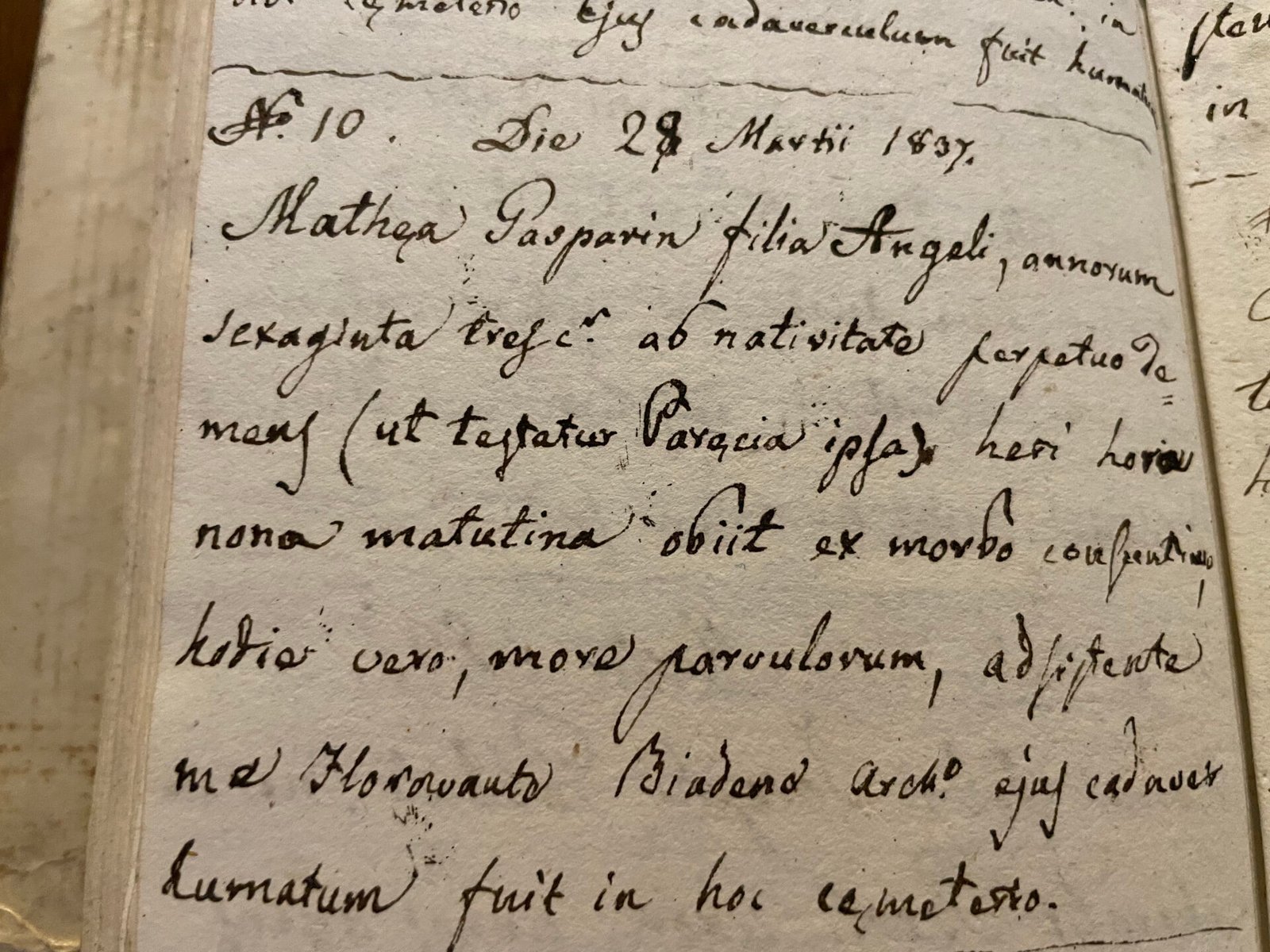
Worth remembering: a comune can hold several parishes, and a parish's registers don't automatically move when the diocese reorganises. Always confirm current location on BeWeB before assuming "diocesan archive" or "still at the parish" — I've been caught out by that assumption more than once.
Layer 4 — Surnames
Where surnames live
The surnames of my working register — twelve thousand names, dated and sourced — live in the participants database, and one room per documented line is opening at a time in the surname shelves. In Veneto research the rule never changes: a surname is a clue, not a proof — it becomes a family only when a register says so.
Start
Two ways in
Read the guides and case stories first if you want the full context before writing to archives, or skip straight to starting your own research: every research begins with a first letter.
This overview shows you the structure of the sources; the fieldwork is made of folders to leaf through and gaps to steer around with experience. If you want to turn simple clues into a solid, documented family tree — one where every name stands where a register put it — write to me for a preliminary analysis of your case. — Marina Martello, genealogist