
Field notes from Marina Martello, a Trentino-Alto Adige genealogist.
Genealogy Research in Trentino-Alto Adige: Dioceses, Parish Records & Civil Archives
In the silence of the Trentino archives, your family history is written with a rigour that takes your breath away — but in a language and a script that can shut out anyone who isn't of the trade. With no civil registry until 1924, every ancestor of yours exists only within the parish pages of the old County of Tyrol: one surname misread in old German Kurrent cursive, and centuries of memory can slip away.
This region only joined Italy in 1918–1920, half a century after Veneto — the whole of Trentino and South Tyrol was County of Tyrol, Austria, for over five hundred years. That single fact governs almost everything below: one shared civil-records date (1 January 1924) instead of Veneto's patchwork, a diocese that was split down the middle in 1964 rather than merged, and — unlike anywhere else in this collection — a real chance that the surname on a 1930s document isn't the family's original one at all. Same empire, three peoples: Italian in Trentino, German across most of South Tyrol, and Ladin, Mòcheno and Cimbrian in a scatter of alpine valleys that answer to neither. This Trentino-Alto Adige dioceses parish records genealogy guide maps both dioceses and ten comuni, cabinet by cabinet.
Church bank — diocese, parish, to 1923State bank — comune, Archivio di Stato, from 1924
Orientation
What lives where
Compared with Veneto or Friuli Venezia Giulia, this is almost tidy: one border crossing (1918–1920), one transition date (1924), two dioceses. The complexity here isn't in the dates — it's in the languages, and in one archive-side tool that exists nowhere else in this collection. It is also the spine of this Trentino-Alto Adige dioceses parish records genealogy guide.
Parish / diocesan archive
mid-1500s — 31 December 1923
- Baptisms, marriages, deaths — and, right through to the end of 1923, the civil record too. Austria delegated the civil-registrar role to parish priests here exactly as it did in Gorizia and Trieste.
- Both diocesan archives hold parish-register images or copies for research, precisely because those registers carried civil weight.
- Originals generally stay at the parish; the diocesan archive coordinates access rather than holding everything centrally.
Comune / Anagrafe
1 January 1924 — today
- Stato civile italiano, comune by comune — the same handover date confirmed for Trento diocese as for the Archdiocese of Gorizia.
- A January 1923 royal decree had already created the Province of Trento (which then still included Bolzano) and extended Italian law to the territory; the comuni took over day-to-day registration a year later.
- The Province of Bolzano wasn't split off from the Province of Trento until 1927 — the same year Gorizia split from Udine, on the other side of the region.
Archivio di Stato
1810–1813, and 1924 onward
- Napoleonic-era Department of Alto Adige (1810–1813) — but only where Napoleon's Kingdom of Italy actually reached; the rest of Tyrol went to Bavaria instead.
- Post-1924 stato civile italiano, held at the Archivio di Stato di Trento or di Bolzano depending on province.
- Special WWI-era registers for Trentino civilians evacuated to refugee camps in Austria and Bohemia — an unusual source, unique to this region.
Layer 1 — Dioceses
Trentino-Alto Adige dioceses parish records genealogy: the two filing cabinets
Two filing cabinets, but they only took their current shape in 1964 — before that, the Archdiocese of Trento covered both provinces, and the political border didn't match the diocesan one either. Where a field reads "varies by parish", it means exactly that: no single date for a whole diocese until the parish itself confirms it — and online coverage, where it exists, may not be complete.
Archdiocese of Trento
Seat: Trento — metropolitan see of the ecclesiastical province of Trento since 1964.
Diocesan archive: Archivio Diocesano Tridentino — diocesitn.it; established 10 February 1993, statute approved 20 October 1994. Before that, an Archivio della Curia arcivescovile whose records were intertwined with the Prince-Bishopric of Trento (1027–1803).
Parish records from: confirmed by the archive itself: parish-register images are available for consultation from the mid-16th century through 31 December 1923 — exact opening dates still vary per parish.
Diocesan archive vs parish: 421 parish archives of the diocese are recognised as historically significant; a systematic inventory project has run since 1985 (many inventories are free online, printed versions sit in the reading room). Originals generally stay at the parish — the diocesan archive authorises and coordinates access, and holds digital images and microfilm rather than the originals as a rule.
Online portals: Nati in Trentino — a dedicated free genealogy database, live since 2010, funded by the Province's Emigration Office, covering births 1815–1923; the AST (Archivi Storici del Trentino) system for parchments; BeWeB — coverage varies by parish and may not be complete.
Notes: erected in the 2nd century, one of the oldest dioceses in the Alps. Historically its territory didn't match the civil province at all: Valsugana and Primiero belonged to the Diocese of Feltre, Val di Fassa to Bressanone. The 1964 reorganisation finally aligned diocese with province — Trento ceded its South Tyrolean deaneries to the new Bolzano-Bressanone, and also handed Magasa and Turano to Brescia diocese and Velo d'Astico and Pedemonte to Vicenza diocese. A 1920 plan to do exactly this was shelved after a nationalist backlash, and only carried out 44 years later.
Diocese of Bolzano-Bressanone
Seat: dual — curia and bishop's residence at Bolzano/Bozen, cathedral at Bressanone/Brixen (co-cathedral at Bolzano).
Diocesan archive: Archivio Diocesano di Bressanone (Diözesanarchiv Brixen), at the Hofburg, Bressanone — a privately-owned diocesan archive combining the Court archive, the Consistory/Ordinariate archive and the Cathedral Chapter archive. The core of the Prince-Bishopric's own secular-government archive sits instead at the Archivio di Stato di Bolzano, not here.
Parish records from: varies by parish — no single date to quote.
Diocesan archive vs parish: varies by parish — the archive has published an online finding aid covering over 77,000 items, searchable through its own information system (DAB), though this is an inventory of what exists, not full digitisation; book a visit at least a week ahead.
Online portals: Diocesan Archive Bressanone online inventory (77,000+ items); BeWeB — coverage varies by parish and may not be complete.
Notes: created 6 July 1964 (bull Quo aptius) by joining the South Tyrolean portion of the Archdiocese of Trento to the much older Diocese of Bressanone (itself tracing to the 6th-century Diocese of Sabiona/Säben); took effect 1 September 1964, and became suffragan of the newly metropolitan Trento the next day, 6 August 1964 (bull Tridentinae Ecclesiae). The same 1964 bull moved the diocese's parts in Belluno province — Colle Santa Lucia, Livinallongo del Col di Lana, Cortina d'Ampezzo — to the Diocese of Belluno-Feltre instead (see the companion Veneto guide). Organised pastorally around three language groups: German, Italian, Ladin.
Layer 2 — Civil records
Civil records, comune by comune
Ten comuni across both provinces. The handover date barely moves here — what changes is what came before it, and it's genuinely three-way: Napoleonic Italy, Bavaria, or straight Austrian continuity.
| Comune | Province | Civil records from | Before that | State archive |
|---|---|---|---|---|
| Trento | Trento | 1 January 1924 | Napoleonic — Dipartimento dell'Alto Adige | Archivio di Stato di Trento |
| Rovereto | Trento | 1 January 1924 | Napoleonic — Alto Adige | Archivio di Stato di Trento |
| Riva del Garda | Trento | 1 January 1924 | Napoleonic — Alto Adige — exact border detail not confirmed per comune | Archivio di Stato di Trento |
| Cles (Val di Non) | Trento | 1 January 1924 | Napoleonic — Alto Adige — attribution not confirmed per comune | Archivio di Stato di Trento |
| Luserna / Lusérn — Cimbrian minority | Trento | 1 January 1924 | Not confirmed — a Cimbrian-speaking linguistic island distinct from South Tyrol's German majority; its Napoleonic-era department attribution remains to be verified | Archivio di Stato di Trento |
| Fierozzo — Mòcheno minority | Trento | 1 January 1924 | Not confirmed — one of three Fersina-valley comuni (with Palù del Fersina, Frassilongo) where Mòcheno, a separate Germanic minority language, is spoken; Napoleonic-era attribution not confirmed | Archivio di Stato di Trento |
| Bolzano / Bozen | Bolzano — est. 1927 | 1 January 1924 (as part of the then-Province of Trento; Bolzano province itself only from 1927) | Napoleonic — Alto Adige (the city, Überetsch-Unterland, parts of Salten-Schlern and Burggrafenamt) | Archivio di Stato di Bolzano |
| Merano / Meran | Bolzano | 1 January 1924 | Napoleonic — Alto Adige — exact extent not confirmed per comune | Archivio di Stato di Bolzano |
| Bressanone / Brixen | Bolzano | 1 January 1924 | Likely outside the Kingdom of Italy's department, possibly Bavarian 1810–1813 — not confirmed here | Archivio di Stato di Bolzano |
| Dobbiaco / Toblach | Bolzano | 1 January 1924 | Napoleonic — Dipartimento del Piave, not Alto Adige | Archivio di Stato di Bolzano |
The 31 December 1923 / 1 January 1924 handover is confirmed directly by the Archivio Diocesano Tridentino for the whole of the old diocese. Treat it as solid for Trento province; for Bolzano province specifically, corroborate against the Archivio di Stato di Bolzano before quoting it comune by comune.
Layer 3 — Method
How to actually find a parish register
This is the one guide in the set where you may not need to write to an archive at all before checking a purpose-built database first.
1. Try Nati in Trentino before anything else. For the Trento side, the Provincia Autonoma di Trento's own genealogy database — natitrentino.mondotrentino.net — indexes births recorded 1815–1923 and is free to search. It was built specifically for emigrants' descendants and citizenship applicants, so start here rather than with a general search.
2. Confirm the parish with an Annuario or parish finder. Parish boundaries here shifted with the 1964 diocesan reorganisation as much as with any older event — a village's parish may have answered to Trento before 1964 and to Bolzano-Bressanone after. Cross-check the current parish and diocese with the CEI's own parish finder or an Annuario Cattolico before writing to anyone.
3. Use each archive's own finding system. For Trento diocese, the AST (Archivi Storici del Trentino) system covers parish parchments at low resolution online, high resolution in person; printed inventories for many of the 421 recognised parish archives sit in the diocesan reading room. For Bolzano-Bressanone, the Hofburg's own DAB information system now lists over 77,000 items — check it before booking a visit, which needs at least a week's notice.
4. Know the WWI refugee-camp registers exist. Thousands of Trentino civilians were evacuated to refugee camps in Austria and Bohemia during WWI. Some of those camps — Mitterndorf, Braunau, Landegg among them — kept their own birth registers, and copies now sit at the Archivio Diocesano Tridentino and are indexed in Nati in Trentino. If a Trentino ancestor's birth record is missing from the home parish for 1915–1918, this is where to look next.
Before you trust a 1920s–30s surname: under the Fascist Italianisation campaign led by Ettore Tolomei, German (and some Ladin) surnames in Alto Adige were officially translated or altered from the early 1920s onward — a documented example turned "Rabeschwarz" into "Corvonero." A surname on an Italian civil or church record from this period may not be the family's original form. If a South Tyrolean line seems to dead-end in Italian, it's worth checking whether an Italianised version is hiding an earlier German one.
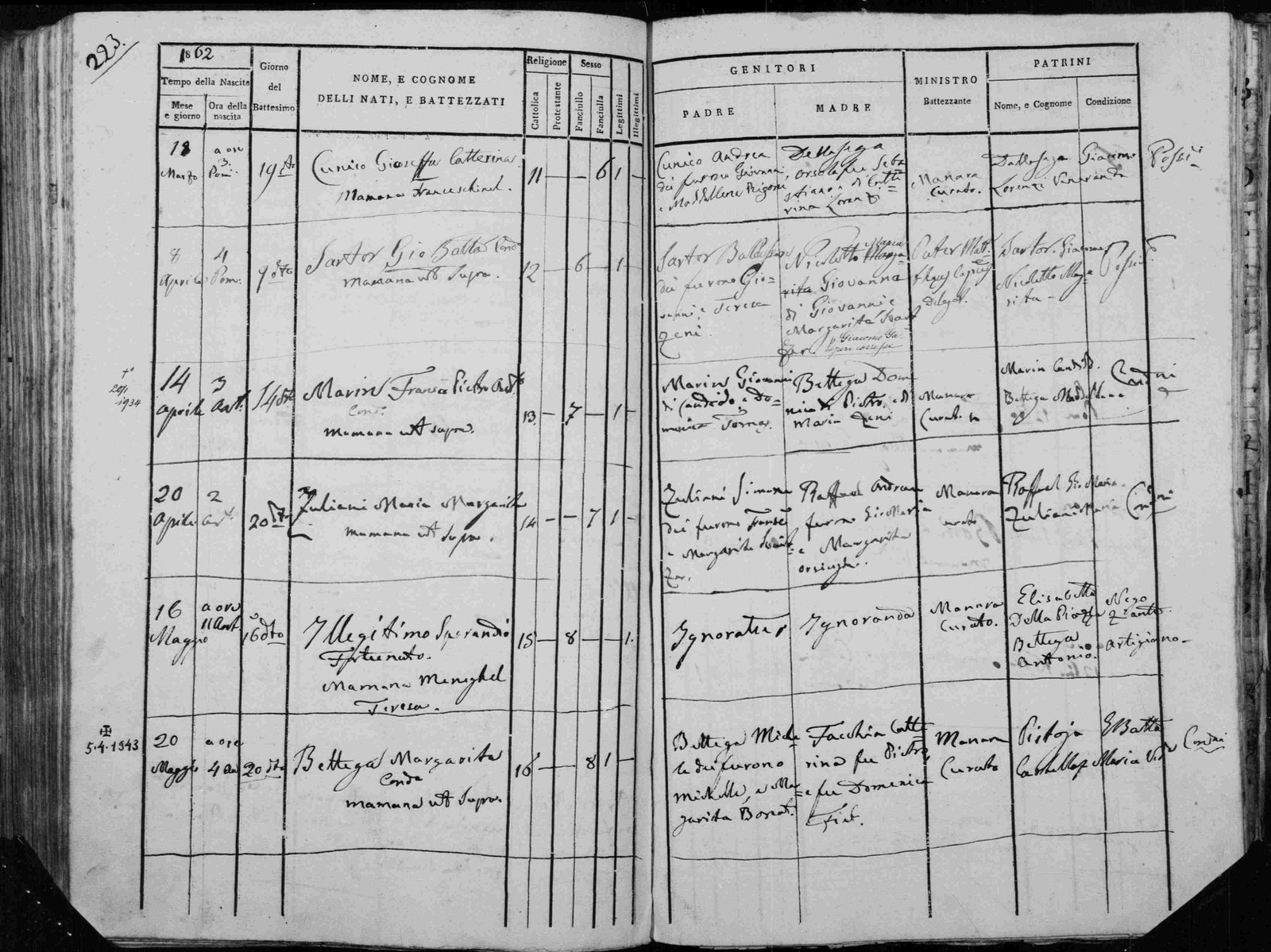
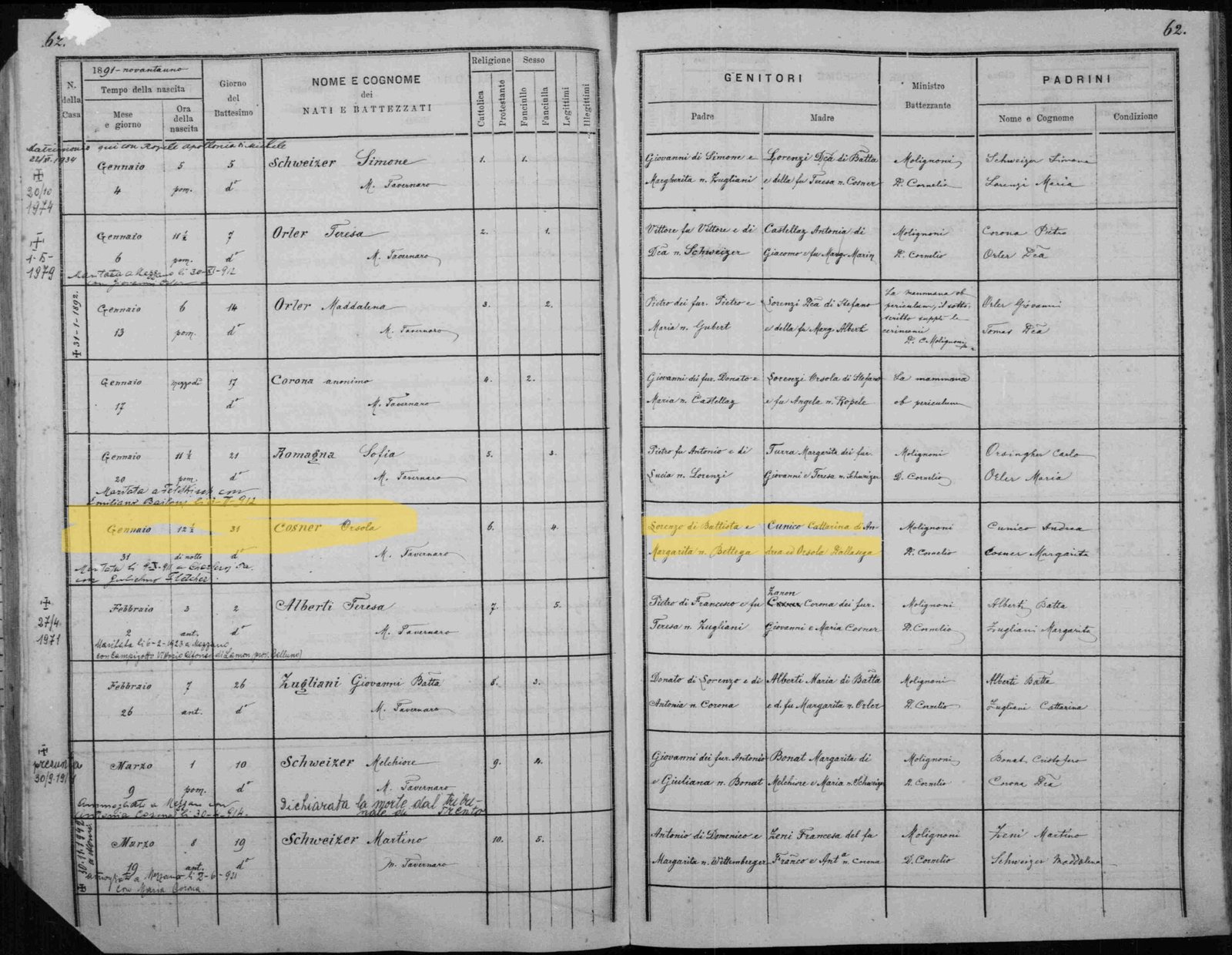
5. Follow one name across the registers, not one register across the names. The two pages below are the same register, twenty-nine years apart, and the same woman: baptised on the 1862 page as Cunico Gioseffa Catterina, daughter of Cunico Andrea and Bettiga Orsola; standing on the 1891 page as Cunico Catterina, mother of Cosner Orsola, with her own father Cunico Andrea as godparent. When a line seems to stop, don't change archive — change decade: the child you baptised is very often the mother you're missing.
Layer 4 — Surnames
Where surnames live
In Trentino-Alto Adige a surname can be a translation, not a family. The Fascist Italianisation campaign of the 1920s–30s, orchestrated by Ettore Tolomei, officially altered German and some Ladin surnames — "Rabenschwarz" became "Corvonero", "Weiss" became "Bianchi", and hundreds more followed the same rule. A surname appearing in Italian form on any civil or church record of that period may be a translation, not a biological family name — and the original German form may be needed to go back further. Separately: Mair/Mayr and Pichler are the dominant German-origin surnames in Bolzano province (Pichler reported as the single most frequent by at least one source), Gasser is strongly concentrated there, and Moser is one of the few German-origin names common across both provinces. In Trentino proper, Degasperi and Bortolotti are almost exclusively regional; Chistè, Bertagnolli and Dalpiaz are non-German surnames concentrated almost entirely within the region and worth recognising as regional markers in their own right. Read each as a clue to a language and a decade, never as a proof of a line.
The surnames of my working register — twelve thousand names, dated and sourced — live in the participants database, and one room per documented line is opening at a time in the surname shelves. Here as everywhere: a surname is a clue, not a proof — it becomes a family only when a register says so.
Start
Two ways in
Read the guides and case stories first if you want the full context before writing to archives, or skip straight to starting your own research: every research begins with a first letter.
This page shares its fields with the Veneto, Friuli Venezia Giulia, Emilia-Romagna, Liguria and Lombardy guides — so records line up across the whole collection.
Don't let your family's story stop at a document you cannot read. Deciphering these papers is not a matter of luck, but of surgical precision: write to me today, hand me your Trentino branch, and let's turn that old doubt into a certain name. — Marina Martello, genealogist