
Yet, retrieving an elusive birth record from an isolated parish or navigating a provincial State Archive presents real hurdles: misspelled surnames, lost civil registers, and fragmented documentation. Without formal archival methodology, family research quickly stalls.
Primary-Source Standard: Professional genealogy in Italy relies strictly on official civil registers, diocesan acts, and military draft rolls to establish verifiable familial truth, eliminating the guesswork of unverified online trees.
A Historic Milestone for Italian Genealogy: The MIMIT Recognition
In countries like the United States and the United Kingdom, professional genealogy adheres to established credentialing standards and ethical codes. In Italy—home to one of the most comprehensive archival reserves on earth—the field historically remained fragmented.
That gap is now officially closed.
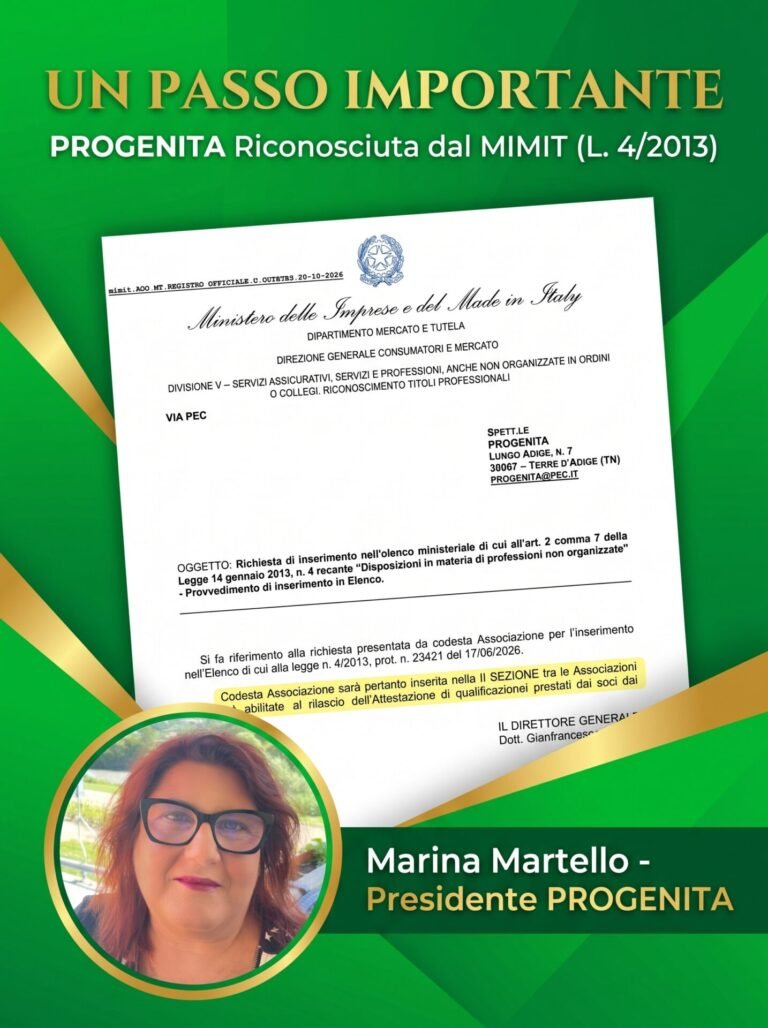
The Italian Ministry of Enterprises and Made in Italy (Ministero delle Imprese e del Made in Italy – MIMIT) has officially approved the entry of PROGENITA – Professionisti Genealogisti Italia into Section II of the public registry of professional associations, pursuant to Italian Law No. 4 of January 14, 2013.
What Does Section II Recognition Mean?
Under Italian national law, Section II is specifically reserved for associations legally empowered to issue an Attestation of Quality and Professional Qualification (Attestazione di qualificazione professionale dei servizi) for the services provided by their members.
For international families seeking their ancestry, this distinction creates three clear safeguards:
- Verified Archival Competence: Proven expertise in paleography, Latin, ancient regional dialects, and the navigation of both ecclesiastical and civil repositories.
- Mandatory Continuing Education: Ongoing training in historical research methodology, archival conservation standards, and record interpretation.
- Consumer Protection: A legally mandated Citizens’ Guarantee Desk (Sportello del Consumatore, Art. 2, Par. 4, Law 4/2013) ensuring transparency, ethical conduct, and accountability.
| Research Aspect | Informal Online Research | Certified Archival Research (PROGENITA Standard) |
|---|---|---|
| Source Type | Digital transcriptions, unverified user trees | Original primary documents (Stato Civile, Parish, Military) |
| Evidence Standard | Indirect clues and hypotheses | Rigorous archival corroboration |
| Repository Reach | Limited to indexed online records | On-site access to local municipal, diocesan, and state archives |
| Professional Oversight | None | Governed by Law 4/2013 and professional codes of conduct |
Archival Rigor on the Ground
As President of PROGENITA and founder of Pro Italian Roots, my professional focus centers on a clear principle: family history is documentable truth, not speculation.
Tracing ancestry directly in Italy requires navigating distinct tiers of local records:
- Municipal Archives (Comuni): Accessing civil vital records (atti di stato civile) to establish multi-generational timelines.
- Diocesan and Parish Archives: Examining baptismal, marriage, and confirmation registers, often dating back centuries before civil registration began.
- State Archives (Archivi di Stato): Consulting military draft lists (liste di leva) and notarial records to locate ancestral hometowns and clarify identity records.
Certified genealogical research protects your family memory, ensuring your origins are reconstructed with scientific precision and historical integrity.