
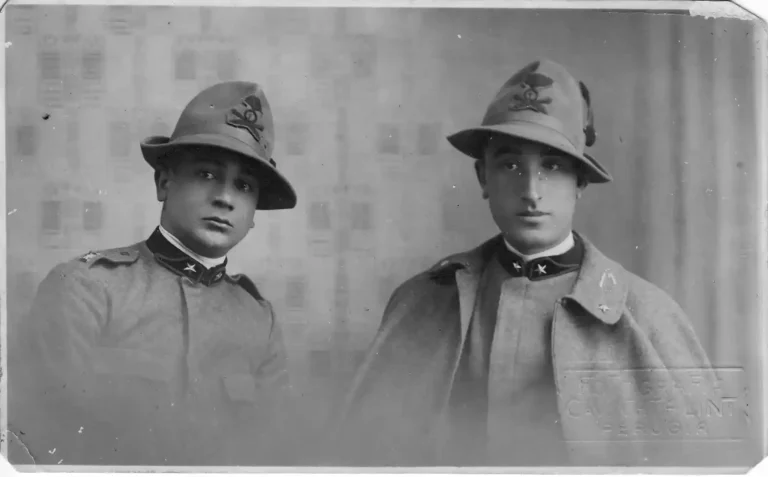
Somewhere in an Italian draft list, your great-grandfather stands 5 feet 4 inches tall. His hair is chestnut, his nose is “regular,” a scar crosses his left hand, and he can read but cannot write. For most families no photograph of that man survives. The draft list does.
Military records answer what parish registers and civil acts cannot: what he looked like, how he earned a living, whether he was literate, and sometimes the year he left for America. This guide covers the four record types, where to search for free, and how to order what is not online.
Four Records, One Man’s Story
Every Italian male was tracked by the state, and each record picks up at a different moment in his life. The state counted him whether he served, was rejected, or had already emigrated.
| Record | Italian name | Who appears | Best for |
|---|---|---|---|
| Draft list | Lista di leva | Every male of the birth-year class | Physical description, occupation, literacy, verdict |
| Lottery list | Lista di estrazione | Men who drew a lot number | Whether he served long term or short term |
| Service record | Foglio matricolare | Only men inducted into a unit | Units, campaigns, wounds, travel abroad |
| Medical rejection | Verbale di riforma | Men rejected for health reasons | The exact medical reason |
The Class of the Year
Italian conscription grew out of the Piedmontese system (the La Marmora law of 1854). It spread as the kingdom did: most of the peninsula in 1861, the Veneto in 1866, and Lazio in 1870. In the south and in the former Papal States, many families saw the draft as a heavy burden that took working hands away for years. Some sons emigrated before their number came up.
Everything in military research runs on the class of the draft (classe di leva):
- The class is the man’s birth year. A man born in 1888 belongs to the Class of 1888.
- The medical examination took place around age 20, with variations from one reform to the next. For a man born in 1888, that means about 1908.
- The state listed every male born or resident in the territory. That is why rejected men and early emigrants still appear.
The Four Records
The Draft List (Lista di Leva)
The town hall’s registry office compiled the list each year and sent it to the military authorities of the district. It names every young man of the class born or resident in the comune.
- Name, father’s name, and mother’s name;
- Date and place of birth;
- Residence and declared occupation;
- Literacy (sa leggere, sa scrivere, analfabeta);
- Medical findings: height, chest measurement, hair, eyes, skin tone, nose shape, and distinguishing marks;
- The verdict of the draft board.
| Verdict | Meaning in Archival Practice |
|---|---|
| Abile | Fit for service, therefore inducted into the military rolls. |
| Rivedibile | Sent back for re-examination the following year, usually for a weak build or small chest. |
| Riformato | Permanently exempted for a diagnosed physical defect or illness. |
| Renitente | Absent at the official call without an authorized excuse. |
The Lottery Lists (Liste di Estrazione)
For decades after unification, not every fit man served a long term. His fate was decided by drawing a number. Low numbers went to continuous active service in the first category. High numbers went to short terms or unlimited leave in the second or third category.
The Service Record (Foglio Matricolare)
This record exists only for men who were inducted. The army kept updating it until the man’s service obligations ended, roughly between ages 45 and 55.
- Initial regiment or battalion assignment;
- Induction dates, promotions, and changes of unit;
- Campaigns: Eritrea, Libya, World War I, Spain, World War II;
- Wounds, hospital stays, and medals of honor;
- Notes on travel abroad: passports issued and permits to live outside Italy.
The Medical Rejection Records (Verbali di Riforma)
If your ancestor was rejected, the medical files give the exact reason: hernias, heart conditions, missing front teeth (needed to tear cartridges in muzzle-loading rifles), foot malformations, or height below the required minimum (typically around 154 cm).
Reading the Physical Description
For farmers and laborers, a photograph was a luxury. The draft list often holds the only physical description of the head of the family.
| Entry | What it tells you |
|---|---|
| Height | A direct clue to childhood nutrition, physical labor, and material conditions. |
| Hair and eyes | Precise color shades: castano chiaro (light brown), bruno (dark brown), ceruleo (sky blue), grigio (gray). |
| Teeth | Sound, decayed, or missing teeth. |
| Distinguishing marks | Scars from farm accidents, burns, smallpox marks (vaiolato), tattoos. |
| Complexion | Skin color described as pallido, bruno, sano, or sanguigno. |
Where to Search Online for Free
The older military registers sit in the provincial State Archives (Archivio di Stato), and a large share is already digitized.
- Portale Antenati: The national portal hosts records from State Archives at antenati.cultura.gov.it. Select the province and look for Leva militare, Liste di leva, or Ruoli matricolari. Open the volume for the correct class and check the alphabetical index (rubrica) in the first or last pages.
- FamilySearch: Browse the catalog at familysearch.org by province name followed by Italy, checking under Military records.
- Albo d’Oro della Grande Guerra: Free database documenting over 600,000 Italian servicemen who died in World War I.
- OnorCaduti: Official search tool of the Italian Ministry of Defense for fallen and missing personnel from 1915 onward.
How to Request Records by Mail
If the volumes are not online, write to the State Archive that holds them. Older registers have been transferred from military districts to State Archives, while recent classes remain subject to specific privacy rules.
sto conducendo una ricerca genealogica sulla mia famiglia e vorrei richiedere copia della lista di leva e, se esistente, del foglio matricolare di [Cognome Nome], figlio di [nome del padre] e di [nome e cognome della madre], nato a [comune] il [data], classe di leva [anno].
Vi chiedo cortesemente di indicarmi modalità, tempi e costi per la riproduzione digitale. Ringrazio e porgo distinti saluti.
Four Traps That Stop Researchers
Young boys who emigrated with their families still appeared on municipal draft lists. When they failed to report, they were marked as renitente alla leva, presunto emigrato in America. This entry proves the family’s departure window.
The draft list followed the family’s residence when the list was compiled at age 17, not always the place of birth. Check the family's last known town if the record is missing in the village of origin.
Ancestors from Trentino, South Tyrol, Trieste, Gorizia, or Istria before 1918 served in the Austro-Hungarian army (k.u.k. Armee). Their service sheets (Grundbuchblätter) sit primarily in Vienna or regional archives.
Thousands of Italians living in the United States, Canada, Brazil, or Argentina sailed home in 1915 to serve in the First World War. Their military files carry consular departure stamps and return permits.
Your Starting Checklist
- I have the ancestor’s full name, his parents’ names, and his birthplace.
- I calculated his class of the draft (his birth year).
- I checked whether his residence at 17 differs from his birthplace.
- I searched Portale Antenati and FamilySearch.
- If he came from a Habsburg territory, I considered the Austrian archives.
- I checked the databases of the fallen (Albo d’Oro, OnorCaduti).
- If nothing is online, I wrote to the correct State Archive.
Questions Families Ask First
If my ancestor emigrated before age 20, is he still in the records?
Yes. He was entered on the draft list of his birthplace or residence, and if he did not appear, he was recorded as a renitente.
What is the difference between the draft list and the service record?
The draft list covers every young man of the class and documents the medical exam. The service record exists only for those inducted and follows their whole military career.
Will I find a photograph?
Almost never. But the physical description is often the only portrait you will get.
Can you retrieve military records for me?
Yes. Our team conducts on-site searches in parish registers, civil archives, and military rolls directly in Italian archives. Contact us with the surname, municipality, and approximate dates.