
An Italian family tree is more than a decorative chart; it is a strategic roadmap. In Italian genealogy, where records are hyper-local and naming patterns repeat, a well-structured family tree is the essential tool that helps you navigate civil registries, parish archives, and the complexities of Italian ancestral research.
Related guides:
Looking for the records themselves? Start with Getting Started with Italian Genealogy: A Practical Guide, which explains where Italian records are held, how to read them, and how to request them.
Find the parish and diocesan archives of your region in the Italian Dioceses Genealogy Guide.
1. The Anatomy of an Italian Family Tree
A tree starts with a single person, usually you, and branches out to ancestors, siblings, and other relatives. In Italian research, each part of the tree has a specific strategic purpose:
- The Starting Person (You): The base of your pedigree. Your first task is to work back to the immigrant ancestor (or the last ancestor born in Italy) and identify his or her exact Comune (town of origin) before searching Italian records.
- The Branches (Direct and Collateral Lines): Direct lines are your parents, grandparents, and so on. Collateral lines are siblings, aunts, uncles, and cousins. In Italian genealogy, collateral lines are not optional. Because of repetitive naming patterns, researching a sibling's marriage or death record is often the only way to confirm the parents' names of your direct ancestor.
- The Leaves (People Anchored to Sources): Each person on the tree must be tied to at least one document. In Italy, these sources are specific: atti di nascita (birth records), atti di matrimonio (marriage records), atti di morte (death records), processetti or allegati (marriage enclosures), and, for earlier periods, parish registers and Stato delle Anime (parish censuses). You can learn to read these documents in the vocabulary section of our records guide.
2. Best Family Tree Formats for Italian Research
While the classic "tree" shape is popular, professional Italian genealogists rely on specific formats to solve research problems:
A. The Pedigree Chart (Direct Ancestors)
This left-to-right or top-down chart shows only your direct line (parents, grandparents, great-grandparents). It is invaluable for tracking your lineage backward generation by generation to pinpoint the exact Comune and parish where your family originated, without the clutter of extended family.
Genealogists often number the people on a pedigree with the Sosa-Stradonitz system: you are number 1, your father is 2, your mother is 3, and every person's father is double their number and mother is double plus one. This makes it easy to refer to an ancestor in notes ("ancestor no. 12") without confusion.
B. The Family Group Sheet (Scheda di Famiglia)
This is the most critical tool for Italian research. A family group sheet focuses on one couple and all their children. Because Italian families were often large and naming patterns were traditionally strict (the first son was usually named after the paternal grandfather), you will frequently find multiple cousins in the same town with the same name and birth year. A family group sheet forces you to document every child, allowing you to distinguish your ancestor from namesake cousins by tracking who married whom and where they moved.
Do not confuse it with the stato di famiglia. In Italy, a certificato di stato di famiglia is an official certificate listing the members of a household. The family group sheet in this guide is your own research worksheet, not a document issued by the comune.
| Person | Born | Married | Died | Source / notes |
|---|---|---|---|---|
| Husband: Giuseppe ROSSI | 12 Mar 1840, Comune A | 8 Feb 1865, Comune A | 3 Nov 1902, Comune A | Birth act no. 31; marriage act no. 4 |
| Wife: Maria BIANCHI | 2 Jun 1843, Comune B | (same) | after 1902 | Listed under her maiden surname |
| 1. Antonio ROSSI | 5 Jan 1866 | 1890, Comune A | emigrated 1899 | Named after paternal grandfather |
| 2. Pasquale ROSSI | 20 Sep 1868 | ? | 1869 | Died in infancy; name reused for child 4 |
Fictional example. Always add the page or act number, and record infant deaths: names were often reused.
C. The Fan Chart (Seeing Repeated Ancestors)
A circular chart that expands outward from the subject, showing direct ancestors only. It is particularly useful when you discover that the same ancestor appears more than once in your pedigree (known as pedigree collapse). Small, isolated Italian communities, such as mountain villages and islands, often had high rates of marriage within the community, and cousins marrying cousins is well documented through dispensation files.
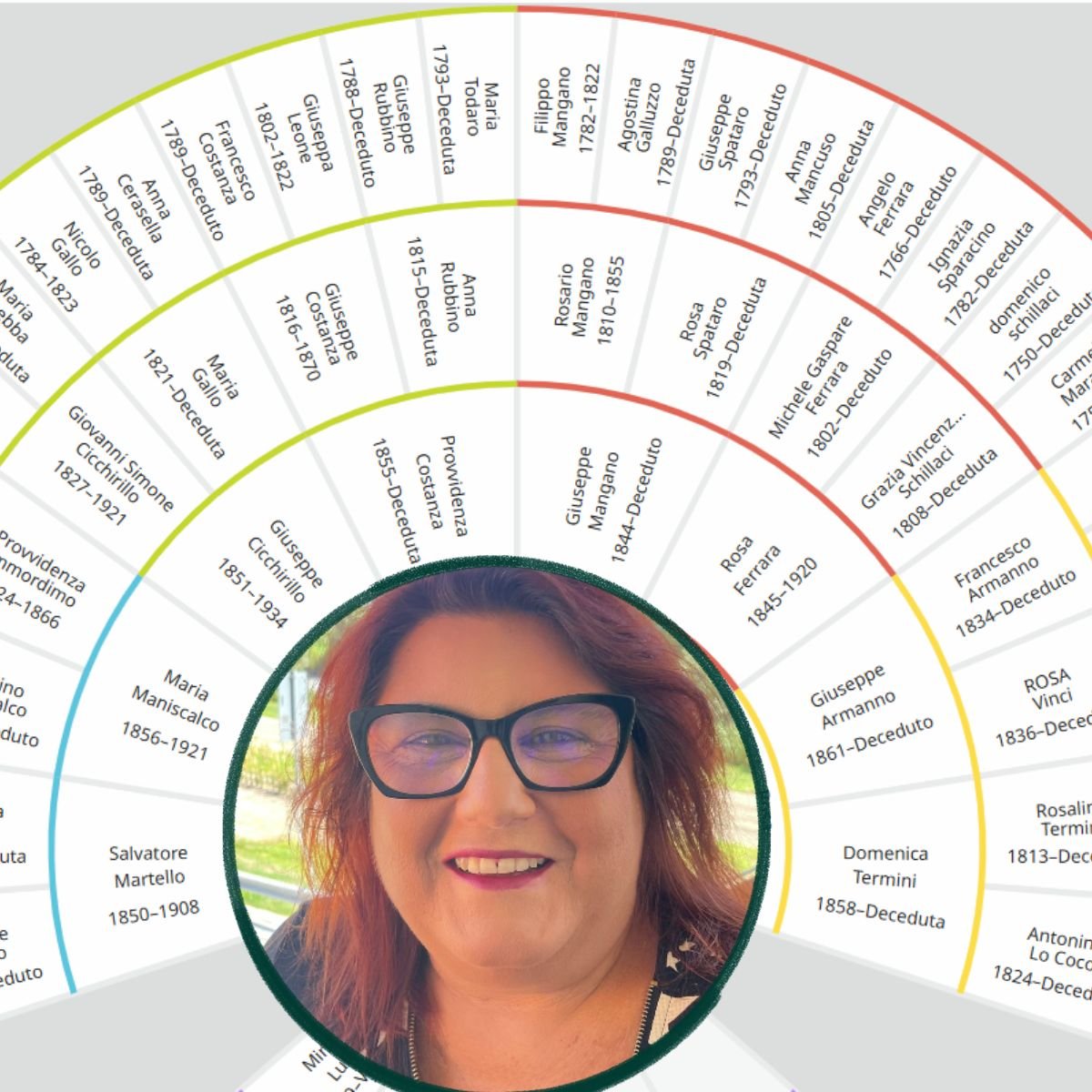
A fan chart helps visualize these converging paths, which is also important when interpreting DNA matches. To interpret a match, the DNA Kinship Decoder shows the average shared DNA and centimorgan range for each relationship. Remember that DNA suggests, while registers prove.
D. The Descendant Chart
This chart starts with an ancestor and works down through all of his or her children, grandchildren, and so on. It is the best way to organize a documented family before you look for living cousins, share information, or compare it with DNA matches.
3. Recording Conventions for an Italian Tree
Consistent habits save you from confusion later, especially when you work with records in different languages and spellings.
- Women under maiden names: Italian women kept their birth surname for life. Enter every woman under her maiden name, and show her husband separately as spouse.
- Dates in day-month-year order, with the month spelled out: Write "12 Mar 1840" to avoid mixing day/month conventions between US and Italian records.
- Places as they were then and as they are now: Record the comune as it appears in the record, with the province, and add the current name or administrative status in a note. Many comuni were merged or renamed, and some territories changed state.
- Names exactly as written: Transcribe spellings as they appear, and record variants and aliases (detto) in notes. Choose one standardized spelling for the tree, but never overwrite what the document says. The Italian Surname Map can help you decide which variant is plausible in a given area.
- Mark uncertainty: Use "about", "before", "after", or "?" for estimated facts, and explain the basis in a note. Avoid inventing dates just to fill a field.
- Keep sources separate from conclusions: Cite the record for each fact and keep a research log of what you searched, including negative results.
4. The Order of Research for Italy
A family tree is not built in a straight line. While you generally start with yourself and move backward in time, Italian research often requires you to move "sideways" or even forward.
- Step 1: Work Backwards in the Arrival Country. Gather every US, Brazilian, Argentine, Canadian, or Australian record (census, naturalization, passenger manifest, church records) to find the ancestral Comune. The Diaspora Bridge section of our records guide lists the most useful sources. Remember that emigrants from the northeast who left before 1918 may appear as "Austrian".
- Step 2: Jump to Italy. Once the town is known, locate the ancestor's birth record in the Stato Civile (civil registers) or in the parish registers for earlier periods, using Portale Antenati and FamilySearch. The start date of civil registration varies by region, as shown in the historical timeline.
- Step 3: Move Sideways (Collateral Research). If your direct ancestor's parents are unclear, research the siblings. A sibling's marriage file (processetti) typically includes the spouses' birth acts and the death acts of any deceased parents or grandparents, which can bridge generations at once. See Strategic Records for what these files contain.
- Step 4: Read the Marginal Notes. Italian birth acts often carry annotazioni a margine, later notes recording events such as marriage, recognition, legitimation, or death, depending on the period and place. A single note can point you to the next record.
- Step 5: Follow the Cluster (Comparatico). In Italian records, witnesses (testimoni) and godparents (padrini) were frequently close relatives or neighbors from the same village, although civil witnesses were not always relatives. Mapping these people on your tree can break through brick walls.
- Step 6: Go Back into the Parish Registers. Before civil registration, use baptism, marriage, and burial books, plus parish censuses (Stato delle Anime) and, where they survive, earlier household lists such as the 18th-century catasti onciari of the Kingdom of Naples. The regional diocese guides show where each region's parish books are kept.
5. Who Should Be Included in Your Tree?
While it is tempting to include only direct ancestors to save time, inclusive research is strongly recommended for Italian genealogy.
The "Small Village" Reality: In a 19th-century Italian comune with a couple of thousand residents, a handful of surnames may account for a large share of the population. If you only track your direct line, you will eventually confuse your ancestor with someone of the same name. By including siblings, in-laws, and even neighbors, you create a network of context that lets you verify identities by cross-referencing.
To see where a surname is concentrated, and which region to search first, use the free Italian Surname Map.
Every family member is an important part of the story, and in Italian research a seemingly unrelated cousin's military record or emigration document might be the exact source that reveals your direct ancestor's birthplace. The annual lista di leva kept by the comune and the foglio matricolare held in the provincial State Archive both name parents, so every brother's file can corroborate the family. See where to find them, and use the Italian Military Service Checker to see which conflicts a man born in a given year could have been called to.
6. Typical Complications in Italian Trees
- Same-name relatives: Cousins, uncles, and nephews may share the same name and birth year. Always identify a person by name, parents, spouse, and place together.
- Infant deaths and reused names: A name given to a child who died young was often given again to a later child. Make sure you have all births and deaths for each couple.
- Second marriages and half-siblings: Widowers and widows frequently remarried (look for vedovo di or vedova di). Children of different marriages may be half-siblings (fratelli consanguinei share a father, fratelli uterini share a mother), so keep the marriages separate on your sheets.
- Children born outside marriage: A child might be recorded as figlio naturale or with an unknown father and later be recognized by a parent, sometimes by a marginal note. Foundlings (esposti) were usually given an assigned surname by the institution.
- Moves and mobility: Many people married in the bride's comune, which is not necessarily the groom's. Look in neighboring parishes.
- Border and state changes: Records for northeastern regions before 1918 (or before 1866 in Veneto) may sit in different archives and administrations. See the timeline of Italian records.
- Endogamy and marriages between relatives: Check dispensation files in parish and diocesan archives; they often spell out the exact relationship of the couple. The DNA Kinship Decoder translates a relationship into the civil and canon-law degrees used in those files.
- Surname and spelling variation: Search by sound and consider aliases (detto). A regional pattern in surnames can help you decide which variant is plausible.
7. Italian Kinship Vocabulary
Italian records and archive catalogs use precise terms for relationships. Knowing them helps you read acts correctly and label your own chart.
| Italian | English | Note |
|---|---|---|
| genitori | parents | Father: padre; mother: madre |
| nonno / nonna | grandparent | |
| bisnonno / bisnonna | great-grandparent | |
| trisavolo / trisavola | 2nd great-grandparent | |
| quadrisavolo / quadrisavola | 3rd great-grandparent | |
| fratello / sorella | brother / sister | Half-siblings: consanguineo (same father), uterino (same mother) |
| zio / zia | uncle / aunt | |
| cugino / cugina | cousin | |
| cognato / cognata | brother-in-law / sister-in-law | |
| suocero / suocera | father-in-law / mother-in-law | |
| genero / nuora | son-in-law / daughter-in-law | |
| nipote | grandchild or nephew / niece | Ambiguous: use the context and the parents' names |
| pronipote | great-grandchild or grand-nephew / grand-niece | Also ambiguous |
| figlio naturale | child born outside marriage | May be recognized later |
8. From Hypothesis to Proof
A tree is a set of hypotheses until each link is supported by evidence. Before you accept that a person in an Italian record is your ancestor, check the following:
- Names: Do the person's name and both parents' names match across records?
- Dates and ages: Are the dates consistent, allowing for approximate ages?
- Place: Is the comune, or a neighboring one, consistent with other documents?
- Relationships: Do spouses, siblings, witnesses, and godparents connect with other known family members?
- Alternatives: Have you ruled out other people with the same name in the same area?
- Conflicts: If sources disagree, record both and explain which one you consider more reliable and why. A birth act written within days of the event is generally more reliable than an age given decades later.
Be especially careful with online family trees: they are often unsourced and copied from one another, so use them as clues, not evidence.
9. Free Tools for Your Italian Tree
Three free tools can support specific parts of the tree-building process. They point you toward the right area or record; they do not replace the documents themselves.
Italian Surname Map
Search more than 70,000 Italian surnames to see where they are documented, helping you narrow the region and understand which surnames were common locally.
Open the mapMilitary Service Checker
Enter a birth year to see which wars a man could have been called to and which state held the levy, a useful guide to the military records of collateral lines.
Check a birth yearDNA Kinship Decoder
See how much DNA you are expected to share with a relative, with realistic ranges, and how the civil and canon-law kinship degrees are counted.
Decode a relationship10. Next Steps: Building Your Italian Tree
- Start with what you know: Document your own family and work backward to the immigrant ancestor using arrival-country records.
- Choose your software: Use a reputable genealogy program (such as Gramps or Family Tree Maker) or a web-based platform that lets you generate family group sheets and pedigree charts, and that lets you attach sources to each fact.
- Source every fact: Never add a name to your Italian family tree without citing the specific record, for example: "Portale Antenati, Archivio di Stato di Napoli, Stato Civile, Comune of [name], Nati 1872, atto no. 45".
- Expand collaterally: Once you reach Italy, document all children of each couple, not just the one who emigrated.
- Read the margins and the enclosures: Check annotations on birth acts and marriage enclosures for links to other records, and write to the comune, archive, or parish when a record is not online.
- Review and revise: Re-examine conclusions whenever you find a new record, and keep a log of negative searches.
Keep researching: Need to find the records to fill in your tree? Continue with Getting Started with Italian Genealogy for archives, vocabulary, and a step-by-step research plan, and use the Italian Dioceses Genealogy Guide to locate the right parish archive.
Professional Research Standard: A family tree is a hypothesis until it is proven by documents. In Italian genealogy, the tree is not built by collecting names, but by meticulously linking each person to an official record from the Comune or Parrocchia. When in doubt, research the siblings.
How Family Trees Work: A Guide for Italian Genealogy Research
An Italian family tree is more than a decorative chart; it is a strategic roadmap. In Italian genealogy, where records are hyper-local and naming patterns repeat, a well-structured family tree is the essential tool that helps you navigate civil registries, parish archives, and the complexities of Italian ancestral research.
Related guides:
Looking for the records themselves? Start with Getting Started with Italian Genealogy: A Practical Guide, which explains where Italian records are held, how to read them, and how to request them.
Find the parish and diocesan archives of your region in the Italian Dioceses Genealogy Guide.
1. The Anatomy of an Italian Family Tree
A tree starts with a single person, usually you, and branches out to ancestors, siblings, and other relatives. In Italian research, each part of the tree has a specific strategic purpose:
- The Starting Person (You): The base of your pedigree. Your first task is to work back to the immigrant ancestor (or the last ancestor born in Italy) and identify his or her exact Comune (town of origin) before searching Italian records.
- The Branches (Direct and Collateral Lines): Direct lines are your parents, grandparents, and so on. Collateral lines are siblings, aunts, uncles, and cousins. In Italian genealogy, collateral lines are not optional. Because of repetitive naming patterns, researching a sibling's marriage or death record is often the only way to confirm the parents' names of your direct ancestor.
- The Leaves (People Anchored to Sources): Each person on the tree must be tied to at least one document. In Italy, these sources are specific: atti di nascita (birth records), atti di matrimonio (marriage records), atti di morte (death records), processetti or allegati (marriage enclosures), and, for earlier periods, parish registers and Stato delle Anime (parish censuses). You can learn to read these documents in the vocabulary section of our records guide.
2. Best Family Tree Formats for Italian Research
While the classic "tree" shape is popular, professional Italian genealogists rely on specific formats to solve research problems:
A. The Pedigree Chart (Direct Ancestors)
This left-to-right or top-down chart shows only your direct line (parents, grandparents, great-grandparents). It is invaluable for tracking your lineage backward generation by generation to pinpoint the exact Comune and parish where your family originated, without the clutter of extended family.
Genealogists often number the people on a pedigree with the Sosa-Stradonitz system: you are number 1, your father is 2, your mother is 3, and every person's father is double their number and mother is double plus one. This makes it easy to refer to an ancestor in notes ("ancestor no. 12") without confusion.
B. The Family Group Sheet (Scheda di Famiglia)
This is the most critical tool for Italian research. A family group sheet focuses on one couple and all their children. Because Italian families were often large and naming patterns were traditionally strict (the first son was usually named after the paternal grandfather), you will frequently find multiple cousins in the same town with the same name and birth year. A family group sheet forces you to document every child, allowing you to distinguish your ancestor from namesake cousins by tracking who married whom and where they moved.
Do not confuse it with the stato di famiglia. In Italy, a certificato di stato di famiglia is an official certificate listing the members of a household. The family group sheet in this guide is your own research worksheet, not a document issued by the comune.
| Person | Born | Married | Died | Source / notes |
|---|---|---|---|---|
| Husband: Giuseppe ROSSI | 12 Mar 1840, Comune A | 8 Feb 1865, Comune A | 3 Nov 1902, Comune A | Birth act no. 31; marriage act no. 4 |
| Wife: Maria BIANCHI | 2 Jun 1843, Comune B | (same) | after 1902 | Listed under her maiden surname |
| 1. Antonio ROSSI | 5 Jan 1866 | 1890, Comune A | emigrated 1899 | Named after paternal grandfather |
| 2. Pasquale ROSSI | 20 Sep 1868 | ? | 1869 | Died in infancy; name reused for child 4 |
Fictional example. Always add the page or act number, and record infant deaths: names were often reused.
C. The Fan Chart (Seeing Repeated Ancestors)
A circular chart that expands outward from the subject, showing direct ancestors only. It is particularly useful when you discover that the same ancestor appears more than once in your pedigree (known as pedigree collapse). Small, isolated Italian communities, such as mountain villages and islands, often had high rates of marriage within the community, and cousins marrying cousins is well documented through dispensation files.
A fan chart helps visualize these converging paths, which is also important when interpreting DNA matches. To interpret a match, the DNA Kinship Decoder shows the average shared DNA and centimorgan range for each relationship. Remember that DNA suggests, while registers prove.
D. The Descendant Chart
This chart starts with an ancestor and works down through all of his or her children, grandchildren, and so on. It is the best way to organize a documented family before you look for living cousins, share information, or compare it with DNA matches.
3. Recording Conventions for an Italian Tree
Consistent habits save you from confusion later, especially when you work with records in different languages and spellings.
- Women under maiden names: Italian women kept their birth surname for life. Enter every woman under her maiden name, and show her husband separately as spouse.
- Dates in day-month-year order, with the month spelled out: Write "12 Mar 1840" to avoid mixing day/month conventions between US and Italian records.
- Places as they were then and as they are now: Record the comune as it appears in the record, with the province, and add the current name or administrative status in a note. Many comuni were merged or renamed, and some territories changed state.
- Names exactly as written: Transcribe spellings as they appear, and record variants and aliases (detto) in notes. Choose one standardized spelling for the tree, but never overwrite what the document says. The Italian Surname Map can help you decide which variant is plausible in a given area.
- Mark uncertainty: Use "about", "before", "after", or "?" for estimated facts, and explain the basis in a note. Avoid inventing dates just to fill a field.
- Keep sources separate from conclusions: Cite the record for each fact and keep a research log of what you searched, including negative results.
4. The Order of Research for Italy
A family tree is not built in a straight line. While you generally start with yourself and move backward in time, Italian research often requires you to move "sideways" or even forward.
- Step 1: Work Backwards in the Arrival Country. Gather every US, Brazilian, Argentine, Canadian, or Australian record (census, naturalization, passenger manifest, church records) to find the ancestral Comune. The Diaspora Bridge section of our records guide lists the most useful sources. Remember that emigrants from the northeast who left before 1918 may appear as "Austrian".
- Step 2: Jump to Italy. Once the town is known, locate the ancestor's birth record in the Stato Civile (civil registers) or in the parish registers for earlier periods, using Portale Antenati and FamilySearch. The start date of civil registration varies by region, as shown in the historical timeline.
- Step 3: Move Sideways (Collateral Research). If your direct ancestor's parents are unclear, research the siblings. A sibling's marriage file (processetti) typically includes the spouses' birth acts and the death acts of any deceased parents or grandparents, which can bridge generations at once. See Strategic Records for what these files contain.
- Step 4: Read the Marginal Notes. Italian birth acts often carry annotazioni a margine, later notes recording events such as marriage, recognition, legitimation, or death, depending on the period and place. A single note can point you to the next record.
- Step 5: Follow the Cluster (Comparatico). In Italian records, witnesses (testimoni) and godparents (padrini) were frequently close relatives or neighbors from the same village, although civil witnesses were not always relatives. Mapping these people on your tree can break through brick walls.
- Step 6: Go Back into the Parish Registers. Before civil registration, use baptism, marriage, and burial books, plus parish censuses (Stato delle Anime) and, where they survive, earlier household lists such as the 18th-century catasti onciari of the Kingdom of Naples. The regional diocese guides show where each region's parish books are kept.
5. Who Should Be Included in Your Tree?
While it is tempting to include only direct ancestors to save time, inclusive research is strongly recommended for Italian genealogy.
The "Small Village" Reality: In a 19th-century Italian comune with a couple of thousand residents, a handful of surnames may account for a large share of the population. If you only track your direct line, you will eventually confuse your ancestor with someone of the same name. By including siblings, in-laws, and even neighbors, you create a network of context that lets you verify identities by cross-referencing.
To see where a surname is concentrated, and which region to search first, use the free Italian Surname Map.
Every family member is an important part of the story, and in Italian research a seemingly unrelated cousin's military record or emigration document might be the exact source that reveals your direct ancestor's birthplace. The annual lista di leva kept by the comune and the foglio matricolare held in the provincial State Archive both name parents, so every brother's file can corroborate the family. See where to find them, and use the Italian Military Service Checker to see which conflicts a man born in a given year could have been called to.
6. Typical Complications in Italian Trees
- Same-name relatives: Cousins, uncles, and nephews may share the same name and birth year. Always identify a person by name, parents, spouse, and place together.
- Infant deaths and reused names: A name given to a child who died young was often given again to a later child. Make sure you have all births and deaths for each couple.
- Second marriages and half-siblings: Widowers and widows frequently remarried (look for vedovo di or vedova di). Children of different marriages may be half-siblings (fratelli consanguinei share a father, fratelli uterini share a mother), so keep the marriages separate on your sheets.
- Children born outside marriage: A child might be recorded as figlio naturale or with an unknown father and later be recognized by a parent, sometimes by a marginal note. Foundlings (esposti) were usually given an assigned surname by the institution.
- Moves and mobility: Many people married in the bride's comune, which is not necessarily the groom's. Look in neighboring parishes.
- Border and state changes: Records for northeastern regions before 1918 (or before 1866 in Veneto) may sit in different archives and administrations. See the timeline of Italian records.
- Endogamy and marriages between relatives: Check dispensation files in parish and diocesan archives; they often spell out the exact relationship of the couple. The DNA Kinship Decoder translates a relationship into the civil and canon-law degrees used in those files.
- Surname and spelling variation: Search by sound and consider aliases (detto). A regional pattern in surnames can help you decide which variant is plausible.
7. Italian Kinship Vocabulary
Italian records and archive catalogs use precise terms for relationships. Knowing them helps you read acts correctly and label your own chart.
| Italian | English | Note |
|---|---|---|
| genitori | parents | Father: padre; mother: madre |
| nonno / nonna | grandparent | |
| bisnonno / bisnonna | great-grandparent | |
| trisavolo / trisavola | 2nd great-grandparent | |
| quadrisavolo / quadrisavola | 3rd great-grandparent | |
| fratello / sorella | brother / sister | Half-siblings: consanguineo (same father), uterino (same mother) |
| zio / zia | uncle / aunt | |
| cugino / cugina | cousin | |
| cognato / cognata | brother-in-law / sister-in-law | |
| suocero / suocera | father-in-law / mother-in-law | |
| genero / nuora | son-in-law / daughter-in-law | |
| nipote | grandchild or nephew / niece | Ambiguous: use the context and the parents' names |
| pronipote | great-grandchild or grand-nephew / grand-niece | Also ambiguous |
| figlio naturale | child born outside marriage | May be recognized later |
8. From Hypothesis to Proof
A tree is a set of hypotheses until each link is supported by evidence. Before you accept that a person in an Italian record is your ancestor, check the following:
- Names: Do the person's name and both parents' names match across records?
- Dates and ages: Are the dates consistent, allowing for approximate ages?
- Place: Is the comune, or a neighboring one, consistent with other documents?
- Relationships: Do spouses, siblings, witnesses, and godparents connect with other known family members?
- Alternatives: Have you ruled out other people with the same name in the same area?
- Conflicts: If sources disagree, record both and explain which one you consider more reliable and why. A birth act written within days of the event is generally more reliable than an age given decades later.
Be especially careful with online family trees: they are often unsourced and copied from one another, so use them as clues, not evidence.
9. Free Tools for Your Italian Tree
Three free tools can support specific parts of the tree-building process. They point you toward the right area or record; they do not replace the documents themselves.
Italian Surname Map
Search more than 70,000 Italian surnames to see where they are documented, helping you narrow the region and understand which surnames were common locally.
Open the mapMilitary Service Checker
Enter a birth year to see which wars a man could have been called to and which state held the levy, a useful guide to the military records of collateral lines.
Check a birth yearDNA Kinship Decoder
See how much DNA you are expected to share with a relative, with realistic ranges, and how the civil and canon-law kinship degrees are counted.
Decode a relationship10. Next Steps: Building Your Italian Tree
- Start with what you know: Document your own family and work backward to the immigrant ancestor using arrival-country records.
- Choose your software: Use a reputable genealogy program (such as Gramps or Family Tree Maker) or a web-based platform that lets you generate family group sheets and pedigree charts, and that lets you attach sources to each fact.
- Source every fact: Never add a name to your Italian family tree without citing the specific record, for example: "Portale Antenati, Archivio di Stato di Napoli, Stato Civile, Comune of [name], Nati 1872, atto no. 45".
- Expand collaterally: Once you reach Italy, document all children of each couple, not just the one who emigrated.
- Read the margins and the enclosures: Check annotations on birth acts and marriage enclosures for links to other records, and write to the comune, archive, or parish when a record is not online.
- Review and revise: Re-examine conclusions whenever you find a new record, and keep a log of negative searches.
Keep researching: Need to find the records to fill in your tree? Continue with Getting Started with Italian Genealogy for archives, vocabulary, and a step-by-step research plan, and use the Italian Dioceses Genealogy Guide to locate the right parish archive.
Professional Research Standard: A family tree is a hypothesis until it is proven by documents. In Italian genealogy, the tree is not built by collecting names, but by meticulously linking each person to an official record from the Comune or Parrocchia. When in doubt, research the siblings.